Meryaten Font: Elevating Campaign Visuals
It was 4:30 PM on a Tuesday, and the deadline for our upcoming seasonal product launch was looming. The creative brief called for something that felt luxurious yet approachable, elegant but not stiff. I had the photography locked in—soft lighting, warm tones, and high-quality textures—but the typography kept falling flat. Standard sans serifs felt too corporate, while heavy slab serifs clashed with the delicate mood of the imagery. That is when I pulled Meryaten from my library of premium fonts.
As a marketing designer, I am always skeptical of new typefaces until I see them perform in a real workflow. Meryaten, available through Script Amp, is not just another decorative script; it is a carefully architected display font that balances rhythmic fluidity with modern clarity. In this review, I want to walk you through how this typeface performed during a live campaign build, focusing on its practical application in digital ads, social media graphics, and brand consistency.
First Impressions and Visual Personality
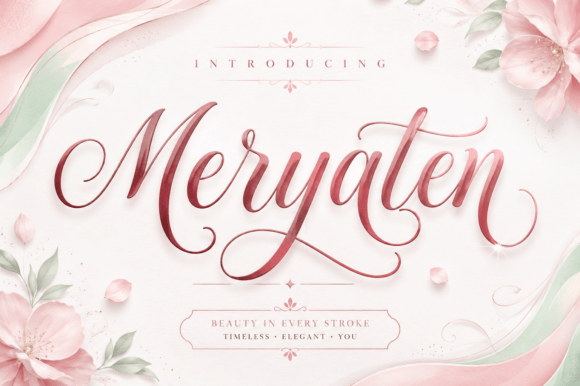
The moment I typed out the headline "Winter Elegance Collection," the difference was immediate. Meryaten possesses a whimsical charm driven by its ornamental swashes, yet it maintains a structural integrity that many handwritten fonts lack. The strokes dance across the baseline, creating a sense of movement that draws the eye naturally from left to right. This is crucial for social media graphics where you have mere seconds to capture attention in a fast-scrolling feed.
What stands out most is the font’s ability to convey luxury without appearing inaccessible. For brand identity projects, this is a delicate balance. Meryaten feels expensive, akin to high-end packaging design or editorial design spreads, but it retains a human touch. It does not scream for attention; instead, it invites the viewer in. This makes it an excellent choice for lifestyle brands, boutique online shops, and service-based businesses looking to soften their visual language.
Performance in Digital Campaigns
I tested Meryaten across several key touchpoints in our campaign workflow, including Instagram carousels, YouTube thumbnails, and email headers. Here is how it held up in each environment:
- Instagram and Pinterest Graphics: On square and vertical canvases, Meryaten shines as a hero element. I used it for quote graphics and product teasers. The ornamental swashes add visual interest that fills negative space effectively, reducing the need for extra graphic elements. However, I learned quickly that less is more. Letting the font breathe against a clean background yielded higher engagement than cluttering it with overlays.
- YouTube Thumbnails: For video content, readability is king. Meryaten works beautifully for short, punchy titles like "New Launch" or "Behind the Scenes." Its distinct letterforms stand out even at smaller preview sizes, provided you keep the text concise. It adds a layer of production value that suggests high-quality content before the viewer even clicks play.
- Email Banners and Landing Pages: In web design contexts, I used Meryaten strictly for H1 headers and call-to-action accents. It creates a strong visual hierarchy, guiding the user’s eye to the most important message. When paired with a clean body text, it elevates the perceived value of the offer.
Readability and Mobile Optimization
One of the biggest challenges with script fonts is legibility on mobile devices. During our A/B testing phase, I noticed that Meryaten performs best when used for short headlines rather than long copy. The fluid strokes can become difficult to decipher if the text size is too small or if the line spacing is too tight.
To ensure clarity on small screens, I adjusted the tracking slightly and avoided placing the text over busy photographic backgrounds. Using a solid color block or a subtle gradient overlay behind the text helped maintain contrast. For dark mode interfaces, Meryaten’s lighter strokes remained visible, but I found that bolding the weight (if available in the specific file variant) or increasing the font size by 10% improved scanability significantly. This typeface is not suitable for dense information, legal disclaimers, or formal corporate communication where neutrality is required. It is a decorative title font, meant to evoke emotion rather than deliver data.
Strategic Font Pairing
A common mistake in modern typography is pairing a complex script with another decorative font. With Meryaten, I found the best results came from contrasting its organic curves with structured, neutral typefaces.
For our campaign, I paired Meryaten with a geometric sans serif font for all subheaders and body copy. This combination created a balanced visual system: Meryaten provided the emotional hook and brand personality, while the sans serif ensured the message was clear and easy to read. Alternatively, a classic serif font can work well for a more traditional, editorial look, but care must be taken to ensure the serif does not compete with the swashes of the script. The goal is complementarity, not competition.
Licensing and Technical Considerations
Before integrating any new asset into a client campaign, verifying the license is non-negotiable. Meryaten is a commercial font, meaning it is cleared for use in digital ads, merchandise, and branded templates. However, always check the specific EULA provided by Script Amp or the font distributor to confirm limits on web embedding or app integration.
Technically, the font file includes various alternates and ligatures that allow for customization. Taking time to explore these features can prevent repetitive letter combinations from looking monotonous in longer titles. Ensure you are using the correct file format (OTF or TTF) for your design software to access these advanced typographic features. For web use, converting to WOFF2 ensures fast loading times without sacrificing quality.
In conclusion, Meryaten is a versatile tool for marketers and designers who need to inject warmth and sophistication into their visuals. It is not a one-size-fits-all solution, but when applied strategically to headlines, logos, and short-form content, it significantly enhances brand recognition and audience engagement. By respecting its limitations regarding readability and pairing it with clean supporting typography, you can create campaign assets that feel both premium and authentic.