Dinksam Typeface Review: A Playful Handwritten Font
I was staring at a blank brand board for a local artisanal bakery last Tuesday, trying to crack the code on their visual identity. The client wanted something that felt homemade and warm, but not cliché. They explicitly said they didn’t want another sterile, geometric sans serif font that looked like it belonged in a tech startup’s pitch deck. I needed personality. I needed imperfection. That is when I pulled up Dinksam.
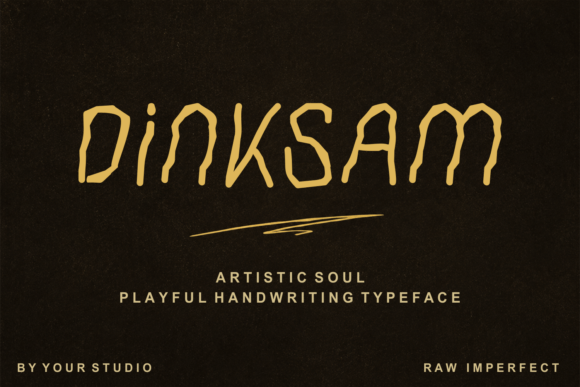
As an experienced brand designer, I have tested hundreds of typefaces, and most handwritten fonts fall into two traps: they are either too messy to read or too polished to feel authentic. Dinksam sits comfortably in the sweet spot between those extremes. It is a playful and expressive typeface that embraces its own irregularities. Inspired by raw sketches and spontaneous hand-drawn lettering, this font features irregular strokes that mimic the natural rhythm of a human hand holding a pen. It does not try to be perfect, and that is exactly why it works.
The Visual Personality of Dinksam
When you first type out a word in Dinksam, the immediate impression is one of approachability. The letters have a bouncy baseline and varying stroke widths that suggest movement. It feels like a note scribbled on a napkin or a label written by hand on a jar of homemade jam. This is not a rigid script font with forced connections; it is a casual, disjointed display font that relies on character rather than uniformity.
In my testing, I found that Dinksam excels at conveying a mood of creativity and informality. It is ideal for brands that want to appear friendly, organic, and human-centric. For the bakery project, I used it for the logo mark. The irregularity of the letters matched the rustic, flour-dusted aesthetic of their products perfectly. It did not look like a computer generated it; it looked like the baker wrote it herself. That subtle psychological cue is powerful in brand identity work because it builds trust through perceived authenticity.
Performance in Real Branding Applications
I took Dinksam through a rigorous workflow to see how it held up across different mediums. Here is how it performed in realistic scenarios:
- Logo Design: As a primary logotype, Dinksam shines. It has enough weight and distinctiveness to stand alone without needing heavy iconography. I tested it in black and white, and the contrast remained strong. It works particularly well for lifestyle brands, cafes, and creative studios.
- Packaging Design: I placed the font on a mockup for a skincare product label. At larger sizes, the texture of the brush strokes is visible and delightful. However, I noticed that when scaled down for small ingredient lists or tiny tags, the finer details began to blur. It is best used as a headline or accent on packaging, not for regulatory text.
- Social Media Graphics: For Instagram stories and posts, Dinksam is a winner. It cuts through the noise of a crowded feed because it feels personal. I used it for quote graphics and promotional headers, and it added a layer of warmth that standard corporate fonts lack. It engages the audience by feeling like a direct conversation.
- Web Design: I tested it in a website hero section. It loaded quickly and rendered cleanly. However, I would advise against using it for body copy or navigation menus. Its strength is in short phrases, headlines, and calls to action. It creates a strong visual hierarchy when paired with a clean, neutral typeface.
Strategic Font Pairing Advice
One of the most critical aspects of using a expressive creative font like Dinksam is knowing what to pair it with. Because Dinksam is so full of personality and irregular movement, it needs a stable partner. I strongly recommend pairing it with a modern, geometric sans serif font or a classic, low-contrast serif font.
For the bakery project, I paired Dinksam with a clean, lightweight sans serif for the subheadings and body text. This created a balanced composition where Dinksam provided the emotional hook, and the sans serif provided the informational clarity. If you pair it with another handwritten or overly decorative font, the design will feel chaotic and unreadable. Let Dinksam be the star, and let your supporting typeface be the stage.
In editorial design or magazine layouts, this pairing strategy holds true. Use Dinksam for pull quotes or chapter headers to break up the monotony of structured text. It adds a human touch to otherwise rigid grids, making the reading experience more enjoyable and less formal.
Limitations and When to Avoid It
While I love Dinksam, it is not a universal solution. It is crucial to understand its limitations to maintain professionalism in your design assets. This is not a font for legal documents, corporate annual reports, or any context where absolute clarity and formality are required. If you are designing for a law firm, a financial institution, or a medical facility, Dinksam’s playful nature may undermine the perceived authority and seriousness of the brand.
Additionally, readability is a concern at small sizes. Do not use Dinksam for long paragraphs of body text. The irregular letterforms and varying heights can cause eye fatigue if the reader has to process too much information in this style. It is strictly a display font meant for short bursts of text. If you need to convey a lot of information, use it only for the title and switch to a highly legible typeface for the content.
Practical Tips for Designers
Before you commit to Dinksam for a client project, there are a few practical steps you should take. First, always check the commercial font licensing. Ensure that the license covers your specific use case, whether it is for print-on-demand products, web embedding, or large-scale merchandise. Intellectual property rights vary, and protecting your client from legal issues is part of your job.
Second, test the font in the actual medium it will be produced in. Screen resolution differs vastly from print quality. I recommend printing a test sheet at the intended size to check for ink bleed or loss of detail, especially if the final output is on textured paper or fabric. For web use, check the webfont availability and ensure it supports the necessary languages if your brand has a global audience. While Dinksam is robust, verifying multilingual support is essential for international projects.
Finally, experiment with tracking and leading. Because Dinksam is irregular, standard spacing settings might not always look right. Tighten the tracking slightly for headlines to create a cohesive unit, or loosen it for a more airy, relaxed feel. Play with the layout until the rhythm of the letters feels natural.
In conclusion, Dinksam is a valuable addition to any designer’s toolkit, particularly for projects requiring warmth, creativity, and a human touch. It is a premium font that delivers on its promise of expressive imperfection. Whether you are refreshing a café’s visual identity, designing packaging for handmade goods, or creating engaging social media content, Dinksam offers a charming and professional solution. Just remember to use it strategically, pair it wisely, and always prioritize readability. When used correctly, it transforms a standard design into a memorable brand experience.