Stiff Ballpoint Font: Raw Handwritten Style for Bold Brands
I was staring at a blank artboard last Tuesday, coffee going cold beside my mouse. The client wanted a brand identity for a small, independent workshop that repairs vintage bicycles and sells handmade leather goods. They didn’t want polished perfection. They wanted grit, history, and the feeling of grease under fingernails. Standard sans serifs felt too sterile, and elegant scripts were completely off the table. That is when I pulled up Stiff Ballpoint.
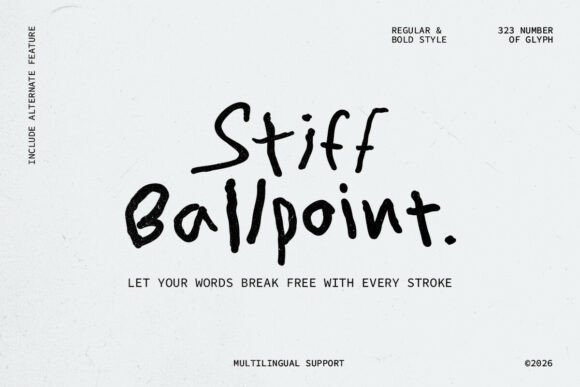
This typeface is part of the Script Amp collection, and it immediately caught my eye because it does not try to be pretty. It tries to be real. As a messy and rough handwritten font family, it brings an immediate sense of human touch to digital screens and printed materials. For this project, I needed a font that could carry the weight of a logo while still feeling approachable and authentic. Here is how I integrated this unique display font into a cohesive brand identity.
Embracing the Imperfect Aesthetic
The first thing you notice about Stiff Ballpoint is its texture. It mimics the look of a ballpoint pen that has been pressed hard against paper, creating those characteristic ink blobs and uneven strokes. This is not a flaw; it is the feature. In modern typography, we often chase clean lines and perfect geometry. However, for brands rooted in craftsmanship, imperfection signals honesty.
I started by typing out the business name in the regular style. The letters felt organic, as if they had been scribbled during a quick brainstorming session. The rough edges gave the logo instant character. When I switched to the bold style, the impact increased significantly. The bold weight is thick and assertive, making it ideal for headlines or primary logos where visibility is key. It holds its own even when scaled down for social media avatars or scaled up for storefront signage.
Leveraging OpenType Features for Natural Flow
One of the most critical aspects of using a handwritten font is avoiding the "robotic" look. If every letter looks identical, the illusion of handwriting breaks. Stiff Ballpoint solves this with contextual alternates in its OpenType feature. This means the alphabet from this font will automatically change certain characters based on their neighbors, creating a more natural flow.
In my design software, I enabled these ligatures and alternates. Suddenly, the connection between letters looked less like a digital font and more like actual penmanship. For a designer, this saves hours of manual tweaking. Instead of manually adjusting kerning pairs or swapping out duplicate glyphs, the font does the heavy lifting. This attention to detail ensures that the brand identity feels consistent and professional, even though the aesthetic is deliberately rough.
From Logo to Packaging: Versatility in Action
Once the logo direction was set, I tested Stiff Ballpoint across various brand assets. A strong brand identity requires consistency, and this typeface proved surprisingly versatile. Here is where it shone brightest:
- Packaging Design: I applied the bold style to kraft paper labels for leather care products. The dark ink against the brown paper created a high-contrast, rustic look that appealed to the target audience. The readability remained high despite the messy style because the letterforms are distinct.
- Social Media Graphics: For Instagram posts announcing new repair services, I used the regular style as an accent font over clean photography. It added a layer of personality without overwhelming the image.
- Printed Marketing Materials: On flyers and business cards, I paired Stiff Ballpoint with a neutral sans serif font. The contrast between the rough handwritten elements and the clean informational text created a clear visual hierarchy. Customers knew exactly where to look for the brand name versus the contact details.
It is important to note that this is primarily a display font. While it is readable in short bursts, it is not suitable for long paragraphs of body text. I reserved it for headlines, quotes, and call-to-action buttons. For longer editorial content on the client’s website, I chose a simple geometric sans serif to ensure comfort and legibility.
Font Pairing and Visual Harmony
Choosing the right companion typeface is crucial when working with a character-rich font like Stiff Ballpoint. Because it has so much personality, it needs a quiet partner. I avoided pairing it with another script font or a decorative serif font, as that would create visual chaos. Instead, I looked for stability.
A modern sans serif worked best. It provided a clean foundation that allowed the handwritten font to stand out as the star of the show. This combination is a classic strategy in creative font usage: let the expressive typeface handle the emotion, and let the neutral typeface handle the information. This balance ensures that the brand perception remains professional while still feeling unique and engaging.
Practical Tips for Designers
If you are considering adding Stiff Ballpoint to your toolkit, here are a few practical observations from my workflow. First, always check the included styles. Having both regular and bold options gives you flexibility in creating emphasis within a single design. Second, test the font at different sizes. What looks great on a large poster might lose some of its intricate roughness when shrunk for a mobile screen. Adjust tracking slightly if needed to maintain clarity.
Also, consider the commercial font licensing. Ensure that your license covers all the intended uses, from web design to physical merchandise. For freelancers and small studios, having a versatile asset like this can streamline the creation of design assets for multiple clients. Whether you are working on a boutique skincare brand, a local restaurant menu, or a creative studio portfolio, this font adds an immediate layer of authenticity.
Ultimately, Stiff Ballpoint is more than just a set of glyphs. It is a tool for storytelling. It helps designers communicate values like craftsmanship, individuality, and raw creativity. By embracing its messy nature and leveraging its technical features, you can create brand identities that feel human in an increasingly digital world. It is a reminder that sometimes, the best design choices are the ones that feel a little bit imperfect.